
Getting lost. Getting there.
Travel in the Philippines can be a lot of fun, especially if you’re into hitting white sand beaches and getting a great tan. But you can get lost when you travel in the Philippines. It is, after all, 7,107 islands in the Pacific Ocean.
The long and the short to travel in the Philippines is that there are four primary international airports that make travel in the Philippines a breeze: three are up in Luzon and one is in Cebu, which is right in the middle of the archipelago.
These airports are your gateways to travel in the Philippines.
The Luzon-based airports are located in Manila (the Ninoy Aquino International Airport) and in the former US air bases in Angeles City, Pampanga (the Clark International Airport) and in Subic Bay, Zambales (the Subic Bay International Airport). The Cebu airport lies in Lapu-lapu City (the Mactan Cebu International Airport).
If you plan to travel in the Philippines, you’d do well to know which airport is nearest to your choice destination. (This isn’t rocket science advice to travel in the Philippines, but worth mentioning nonetheless.)
If you want to go sightseeing tarsiers and the Chocolate Hills in Bohol, or frolic in the white sand beach in Malapascua Island, find out which flights land in the Mactan Airport. This airport is also a nearer take off point (as against Manila) in going to Davao or Siargao.
If you want to go to the ever famous Boracay or Palawan, take a flight that lands in the Manila airport and take a domestic flight going to these places. If you’re flying in on a budget, fly with a budget airline from Malaysia, Singapore or Thailand and land in either Clark or Subic.
Of course, flying in is only the beginning of travel in the Philippines.
Pull out a map of the Philippines and find out how much farther you have to go, and if your destination is separated by sea from the airport. You may have to take a boat or, at best, take a domestic flight. Whatever transportation means is necessary, just make sure you come in prepared with information when you travel in the Philippines.
Don’t hesitate to ask the tourism desk at these airports so you don’t get ripped off and get lost when you travel in the Philippines.
For a more enjoyable and hassle-free stay in a hotel in the Philippines, here are some practical Philippines Hotel guide tips traveling folks should remember.
First, it’s advisable and saves travelers a lot of woes to always reserve in advance with a Philippine hotel before leaving one’s country. Choose a hotel that has a shuttle service to pick up client-guests from the airport to the hotel. Also have itinerary and hotel accommodations pre-arranged in the different places to be visited in the Philippines. This is a very important Philippines hotel guide tip that should make everything work out well as planned and save tourists lots of time and keep them from troubles.
Second, always have pocket money or loose change in Philippine peso denomination, especially before getting to a Manila Airport. It would also be advisable to have some dollar bills available in hand, but keep most of them (especially money in foreign denominations) in banks accessible through ATM or credit cards. The adage to travel light is so true when traveling in the Philippines. So a Philippines hotel guide tip here is the less things we hand-carry, the better, especially when we’re past the airport and in the streets of Philippine cities looking for or proceeding to a hotel. And anyway, many hotels are near ATM booths.
Third, it is safer to travel around Philippines cities, especially when scouting for a hotel, with a resident Filipino companion one knows well, or recommended by someone one knows well. It’s easy to be lost in the streets in this country, and not all local folks can be helpful in such times. Bringing Philippine street maps may be helpful, but this sometimes only makes one’s being lost more obvious to some unscrupulous people. To be sure, there are many friendly and honest locals around, but being extra careful won’t hurt. So, as a vital Philippines hotel guide tip, have a local resident as a traveling companion.
Fourth, choose hotels with travel agency offices or ticketing booths inside them which are relevant to one’s flight options. This way, travelers won’t have to leave their hotels just to secure plane or ship tickets. Not all tourists are booked in packaged tours. Some love independence and adventure and try to find their way around the Philippines by themselves. For this option, make sure to get a hotel with the necessary ticketing and travel needs. That’s a convenient Philippines hotel guide tip.
Travel to and around the Philippines is generally safe. However, as in other countries, there are basic Philippines hotel guide tips for safety and traveling convenience.
Christine Jacinto thought that her new career as a homemaker would mean losing the opportunity to earn her own money. Attending to the needs of her husband, raising her sons (ages 5 an d3), and doing most of the household chores took most of her time that she never imagined she could start her own business. But entrepreneurial as she is, she found herself earning quite a sum of money right at the comforts of her home, specifically in her kitchen, baking cookies.
Q: What made you venture into this business?
A: Ever since I was in high school, I already love baking and cooking. In fact, I have a degree in Hotel and Management and worked with several restaurants before I got married. But with two kids to raise, I decided to just stay at home. So I was left cooking only for my family.
But on several occasions where friends and relatives would get to sample my baking, they would be impressed and some started to place their orders. In most cases, they would delight themselves with the cakes or cookies that I baked. But back then, it was more of a hobby and I only accommodate orders on selective basis.
Q: When and how did you start?
A: I started three Christmases ago. My youngest son’s birthday falls on November 10 and during his first birthday, we had a children’s party at home where I served several baked goodies for the kids. Surprisingly, many of the parents placed their own orders. I found out later that they intended them as gifts for Christmas.
Q: What were the initial problems that you encountered?
A: Quite a lot! Basically because everything was unexpected, I really did not plan to start a business during that time. First was buying the ingredients and other supplies that I needed. Of course I have to shell out some money for them. Thanks to my husband for providing me with the initial capital. Then there is also the problem with packing the goodies since they were Christmas gifts. There was also the problem of meeting with the schedule. Since I was doing the baking myself, it was really tiring.
And as I found it to be an additional source of income, I also have to employ people to assist me and it was hard to get someone you can trust since I have to make sure of the quality of the products. Plus the fact that this was being done at home, you wouldn’t just allow a stranger to enter your home.
Q: How much was your initial capital and how much working capital do you now maintain?
A: More or less around P15,000 which was used mostly to but the ingredients. But I did make additional purchases later on especially for the packaging. Then I also have to buy additional equipment as the orders started to grow.
Right now, my working capital has reached P50,000. And it actually depends on the orders. During Christmas season, I really get a lot of orders so I have to make a lot of purchases.
The Samar Group of Islands has gained so much popularity after its natural beauty and astonishing landmarks were made known. Whether it is the east, west or north of this province that one is going to visit, there are surely Samar destinations that if not visited would be a great opportunity loss. Although it is said that Samar is less developed as compared to other provinces, it is precisely the virgin and unspoiled state of many of its Samar destinations that draws visitors here.
The Calbiga Whitewater River is for the adventure hungry visitor who wants to experience rapids and go rafting or kayaking. The Calbiga Whitewater River passes right through rugged hills and a thick forest and is 18 kilometers long. Watch out for rapids when at this Samar destination and the thrilling drops that range from 3 to 6 meters. In fact there are 70 rapids all in all at the Calbiga Whitewater River and over 120 drops. For those who have never tried rafting, this is definitely one of the things that one should do at the Calbiga Whitewater River and in fact without doing this, the trip is incomplete. Activities such as kayaking and rafting are provided by the Leyte Park Hotel regardless of whether one is a guest or not. These activities are supervised by experts who know how to maneuver the raft and live vests are available. In fact, the Calbiga Whitewater River activities can be enjoyed by children as long as they are 10 years old and above.
There is just something very mesmerizing about caves and one should be prepared to be mesmerized by the Sohotan Cave. This Samar destination was formed over centuries by rock build up and the Sohotan Cave served as the hiding place of our ancestors from tribal battles to the wars. This Samar destination is accessible via public transportation and one just has to get to the town of Borong and take the jeepney or tricycle headed straight for the Sohotan Cave. Once at this Samar destination, there are tourist guides that will walk visitors through the Sohotan Cave and be more than happy to give a little history of the civilizations that used this place as a sanctuary as well as the archeological finds made here. The Sohotan Cave is exceptionally fun for big groups or families who want to spend some quality time bonding.
I remember during my primary and secondary education years in school, whenever somebody would be asking me what would be the best beach resort for me, I always replied, 'Rizal Beach!' Then, everybody around me would gave me their straight faces with the usual question, 'Rizal Beach?' Almost everybody in the classroom did not have any idea what or where Rizal Beach was located; except of course to some of my fellow ‘kababayan’ (native of the same province or region) who knew of the place. Honestly, I felt a bit of disappointment and regret to know that only a few had an idea where or what is Rizal Beach. Nonetheless, I was never embarrassed every time it happened because Rizal Beach was certainly one of the best getaways especially during summer days.
My father was born and lived his first years of his childhood in Gubat, Sorsogon. Some of his siblings as well were born and raised in the same town until our grandparents took risk to have a better life in the concrete jungle of Metro Manila. Since my papa is a Bicolano, as always, whenever we planned to stay in Bicol for quite sometime, we would be staying at Legazpi City (on one of my father's ancestral homes) for a day or two to prepare ourselves as we go to Gubat, Sorsogon. I really love the place because, as we always claim, we have a good 'swimming spot' at the back of our home! There is seashore waiting for us to swim and enjoy. Not to mention the best delicacies our relatives would be giving us.
Whenever my father would be telling us to prepare ourselves to go to Rizal Beach, It would always be a mixed feeling of excitement and lonely anticipation. The 'Rizal Beach Trip' was the signal that our Bicol escapades would soon be over. It was always like that. Nevertheless, the thought of being in this cool place always made me awake the whole night because of exhilaration. After taking out hearty breakfast, we would now be headed to Rizal Beach for the next almost half-a-day of fun. Even the scorching heat of the sun could not tone down our enthusiasm a bit. Since it was our clan's place, we would just stay on one of the best and biggest cottage or cottages available by the shore to secure our things. Cottages during that time were for rent and it was always a 'first come-first serve' policy. We were definitely exempted of this rule since it is 'our place'. Just a short phone call and our relatives would be preparing the place for us. After a long and fun-filled day, we knew that within a day or two we would be going back to Manila.
After finishing college and receiving my diploma, I decided to have a trip to Gubat, Sorsogon after almost ten (10) long years. The accommodation was still the same and certainly it was very special. For years that I had not been here, the local government boosted their efforts in fostering the Eco-Tourism. What I liked best was the ‘Butanding’ or Whale Shark interaction. I was lucky that I was there at one of their peak months (February until May) that I was able to swim with these gentle giants. I never failed to visit my favorite place which was the Rizal Beach and it had surpassed my expectations. Ten (10) years ago, the place was not that developed until my last visit that there were now accommodations along the shore! I was surprised to see some of the famous movie stars relaxing with me as well enjoying my 'favorite' beach.
Sorsogon nowadays is one of the best places to be here in the Philippines. The accommodating and hospitable natives of this wonderful place this feat possible. I am definitely one of the proud Bicolanos to have had witnessed the place's development throughout the years. As our relatives would greet us, 'Dagos Tabi!' which means 'hop in or come in, you are very welcome!'
Dipolog City lies in the island of Mindanao in the Southern Philippines. Located at Zamboanga Peninsula's Northwest rim. Dipolog City's boundaries are Dapitan City on the north, Katipunan on the south, Polanco on the east, and Sulu Sea on the west.
The climate in Dipolog City is moderate and mild. Dipolog City always has an invigorating atmosphere. The cool Northeast Wind locally known as Amihan is the prevailing wind. February to April is the dry season, June to January is the rainy or wet season, and April is the hottest month of the year.
Dipolog City is elevated 2.5 meters above sea level. Most of the areas in Dipolog City are rolling terrain with lowlands. Dipolog River is the main waterway that drains down to Sulu Sea. Other water bodies are also present including Katipunan, Layawan, and Diwan Rivers with Olingan, Gusawan, and Miputak Creeks.
Cebuano is the main dialect used in Dipolog City. Various dialects are also spoken due to tribal groups living in the area.
Dipolog City was once a barrio of Dapitan City. Dipolog became a municipality on July 1, 1913. On June 6, 1952, the Philippines Congress approved Repuclic Act 711 making Dipolog Municipality the capital town of Zamboanga del Norte, Philippines. Dipolog became a chartered city on January 1, 1970 as Philippine President Ferdinand E. Marcos approved Republic Act 5520.
Dipolog City is also known as "The Orchid City". The orchid species referred to are Dipolog City's native orchid called "Pangadlaw". It is a white orchid that symbolizes purity in heart. Dipolog City garnered many honors in academic, sports, cultural, and other competitions in the regional and national levels.
Magsaysay Park is the center of Dipolog City. It's a landscaped park for people to relax, stroll or do early morning exercises. Magsaysay Park is located just in front of City Hall.
The Holy Rosary Cathedral is a symbol of Dipolog City's religious character. Dr. Jose P. Rizal, the Philippines' national hero designed the cathedral's altar in 1894.
The Sta. Cruz marker in Dipolog City is a cross that the migrating Boholanos of the Visayan Island in the Philippines planted on May 3, 1905. This cross faces the Holy Rosary Cathedral on the other end of Rizal Avenue.
The Linabo Peak's 3003 Steps in Dipolog City is conducive for hikers. Linabo Peak is the highest elevated point in Dipolog City. A community chapel was built at the peak, a great place for Lenten season retreats.
Dipolog City has other interesting sites you can't fail to visit when you're there. The Pamansalan-OISCA Forest Park, Sicayab Beach, and Sungkilaw Falls are just a few of the tourist attractions.
There are a lot of hotels and restaurants in Dipolog City so board and lodging is never a problem. From Manila, Philippines you can fly to the Dipolog Airport for about an hour and a half. The locals are friendly and hospitable making your stay enjoyable.
Passi City is located in the heart of Iloilo Province. Passi City's boundaries are San Enrique on the north; on the south is Dumarao, Capiz; Calinog on the east; and on the west is Lemery. Passi City is a mountainous area and is composed of 51 barangays. It has the largest land area in Iloilo Province and is 50 kilometers away from Iloilo City.
Passi City has a variety of dialects. The Passinhon (local natives) speak Karay-a as their predominant dialect. Businessmen and investors use Cebuano and Tagalog dialects as well. Roman Catholicism is the religion of approximately 95 percent of the population in Passi City.
Throughout the Iloilo Province, Passi City is the District Agri-Industrial Center thus making it locally important. Passi City is rich in agricultural resources. Agriculture has been the long time backbone of Passi City's economy. The main agricultural products include pineapples, coconuts, sugarcane, corn, rice, and vegetables.
Aside from agriculture, Passi City also has other industries that contribute well to their economy. These include fruit processing, metalworking production, wallboard production, and cut-flower propagation. Passi City also locally produce pineapple jam, wine, and preserves. These locally produced products have gotten their exposure due to various trade fairs and exhibits. Because of these fairs and exhibits, these products have already an established market.
Passi City has an annual festival called "Pintados de Passi Festival". This festival is one of the very popular and well-established festivals of the region. It is an important event in the life of a Passinhon. The Pintados de Passi Festival attracts local and foreign tourists, which helps the tourism industry of Passi City.
Passi City's Pintados de Passi Festival reminisces lives of the early settlers. These people have their bodies adorned with tattoos. Thus the name "Pintados" or literally the "Painted Men".
The Pintados de Passi Festival of Passi City is celebrated with theatre-like street dancing. Participants do aggressive and heavy body movements to the rhythm of the music. They act out folk plays, character types, combat dances, and other ritual actions. Passi City's rich history and culture play an important role in the preservation of Pintados de Passi Festival.
According to history, in 1766, a Spanish settlement was first established in this area. This marks the Spaniards' onset colonial rule. In Ansig, Spanish explorers anchored there. Ansig is a place located at Lamunan River's delta. Passi City's name is derived from the word "Pasi". This is a Hiligaynon word that means "unhusked grains of rice".
Passi City is a great place to visit if ever you have a chance to come to the southern part of the Philippines. It is a place you shouldn't miss when you visit the province of Iloilo, Philippines.
Are you fond of the outdoors, trekking, hiking, or rock climbing?
If the answer is yes, then Wawa Dam site is the exact place for you. You may even have a feel of the history of the Philippines as you walk along the trail.
Nestled at the foothills of the Sierra Madre Mountains in Montalban, Rizal. The Wawa Dam site is an hour away from Cubao, Manila. It is a place where one can take a time out from the busy streets of Manila city and have fun in the outdoors.
You can get there by taking a jeepney from Cubao going to Montalban. There are also FX-taxis that can take you there (gives more comfort if you wish). This will take you to Barangay San Rafael in Montalban and from there you can take jeepneys that can take you to Barangay Wawa.
If you travel by car you will have to pay a toll fee of twenty pesos for your car. After that you may go wherever you wish in the Wawa Dam site. This is the perfect place for hikers, photographers, trekkers, mountaineers, cave explorers, and every outdoorsman. There are little huts at the dam where you can hang out or have your lunch after a short swim.
The Wawa Dam flanked by limestone walls is a majestic site. The quiet river, the huge limestone rocks, the caves, and the tranquil scenery depict a mystical scene. It is like traveling back in time. The view of the magnificent gorge is awe-inspiring; no wonder a lot of people would love to have a try at rock climbing here.
Local legend has it that Bernardo Carpio, a figure in Philippine Mythology, was once lured into a trap here by the Spaniards. Employing the powers of a shaman, Bernardo Carpio, being a giant in one version, was trapped in between two rocks in the Wawa Dam site. As proof of which, it is said that his hands or feet have been imprinted on the rocks. Local lore also says that one of his teeth was found in one of the caves.
The Wawa Dam was constructed in 1909 by the Americans as a reservoir and pumping facility. It became a battlefield during the Japanese occupation. Many Japanese soldiers died here defending this holding point when the Americans retook the area. A marker was placed in one of the caves that anyone passing through the trail can see. It was placed in honor of these brave men.
One of the caves in the Wawa Dam site is historically significant. The Pamitnan cave is large enough so that it can be explored. It may take an hour for a group to explore the whole cave. In April 1895, it is said that the Philippine revolutionary group KKK (Kataastaasang Kagalanggalangang Katipunan ng mga anak ng bayan) took refuge here. Their first cry of freedom took place here in the cave.
One may feel the embrace of nature while going through the trail. You may have the history of the place instill a spirit of peace and freedom. A trek through the trail at the Wawa Dam site infuses nature's blessings and spirituality into the soul.
The Philippines is blessed with many travel destinations. Each island has something to offer, waiting to be discovered by some intrepid traveler. Most of all each discovery tends to linger in one’s memory.
On the northern part of the archipelago lie its biggest island, Luzon and its numerous mountain ranges inhabited by several religious, industrious tribes. Centuries of their culture and work produced the Banaue Rice Terraces, a prominent travel destination worldwide. While some parts have fallen to modern civilization with concrete fences supporting terraces, they have still retained their ancient wonder that it is considered a must-see travel destination.
Just near the lower end of Luzon, lies another important travel destination, Mayon Volcano. Straddling southern towns and often spewing ash or causing minor tremors, this active volcano has retained its near-perfect cone shape just like its more popular cousin and Japan’s famous travel destination, Mt. Fuji.
The province of Bohol lies near the heart of the Philippines. It is the home of one of the world’s smallest primates, the Philippine tarsier (Tarsius syrichta). Its most famous travel destination is the Chocolate Hills which earned its name when they turn chocolate brown at the end of the dry season. Bohol is also a travel destination because of its beautiful white sand beaches.
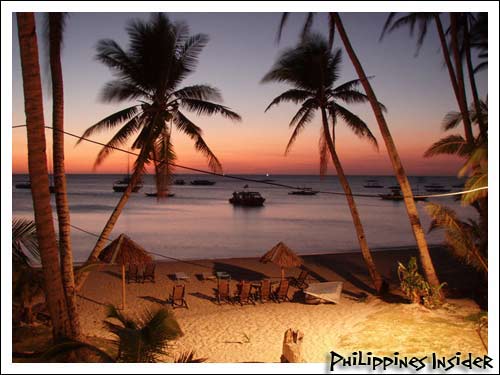 Speaking of beaches, nothing comes close to Boracay located north of the island of Panay. Its white sand beaches are a major travel destination worldwide and it is brimming with tourists during the summer and holiday seasons.
Manila, the country’s capital and also a travel destination by itself, can also be found in Luzon. It is the center of commerce, industry, politics and entertainment. Major historical landmarks such as Jose Rizal’s execution site now transformed into a children’s park is found here. Manila also serves as a major entry or exit point to travel destinations world- and nationwide.
Just west of Luzon lies a cluster of islands commonly known as province of Palawan. The province has earned its reputation as a major international travel destination due to its pristine white sand beaches. Its most famous gem is the Tubbataha Reef, the archipelago’s second World Heritage Site alongside the Banaue Rice Terraces. While the Tubbataha Reef is another travel destination that should be experience by itself, the province of Palawan boasts of other natural wonders such as the kilometers-long underground river.
The Philippines offers a lot more than just ancient and natural wonders. Aside from its beaches and heritage sites, its picturesque towns are home to close to 70 million people known for their smiles and genuine hospitality. It is not surprising that millions flock and make the archipelago their travel destination at least once in their lifetimes.
Because Sorsogon is has a wide agricultural area and long shorelines, its products are a combination of those coming from the farms and those come from the sea. Thus, the province provides many options for people of different tastes and lifestyles.
The pili nut is one of the most popular products of the Bicol region. Almost every province and municipality in the region has their way of preparing food products from this nut. The most common pili preparations are the sugarcoated pili nuts and the pili candies. You will also find pili tarts that are being sold in near Sorsogon tourist spots.
Rice is a staple food in the Philippines and many of the agricultural areas in the country cultivate rice to support the demands of the population. During your travel to Sorsogon, you are likely to find that many of the inland areas are utilized as farms for rice and crops. You will find palays being dried near the roads.
Coconuts are also abundant agricultural products in Sorsogon. It is known to most people that there are many products that may be processed from the coconut tree. The fruit may be eaten fresh and the juice may be served as refreshments. The stem may be processed into coco lumber that is used for furniture and houses. The leaves may be used as broomsticks. Some handicrafts may also be made from coconut products.
Before you leave Sorsogon, one of the coconut products that you must try is the wine made from the juice of the fruit. It has a unique character that you will want to take home some bottles so that your friends can also try it.
Because the province of Sorsogon is bordered waters, the province is also rich in seafood products that are cooked the traditional way. Local fishes, mud crabs, blue crabs and prawns are usually cooked in gata (coconut milk) and spiced with the local sili (pepper).
Upon knowing what the local products of Sorsogon are, it is hard to resist not being able to try them or to take some home with you. The best way to find a selection of quality Sorsogon products is to come to local public market. There, the products are less expensive than if you purchase them near the tourist destinations, bus stops and ports. If you intend to buy quantities of products, don’t forget to try asking for a discount.
